

Server-Driven UI for Python — typed state, zero npm, batteries included.
Bretzel is a full-stack Python web framework for reactive web apps. Python owns the application state and the interface that follows it. The browser receives targeted HTML updates through a small runtime built on HTMX and idiomorph: no React application, no duplicated client store and no npm pipeline to operate in production.
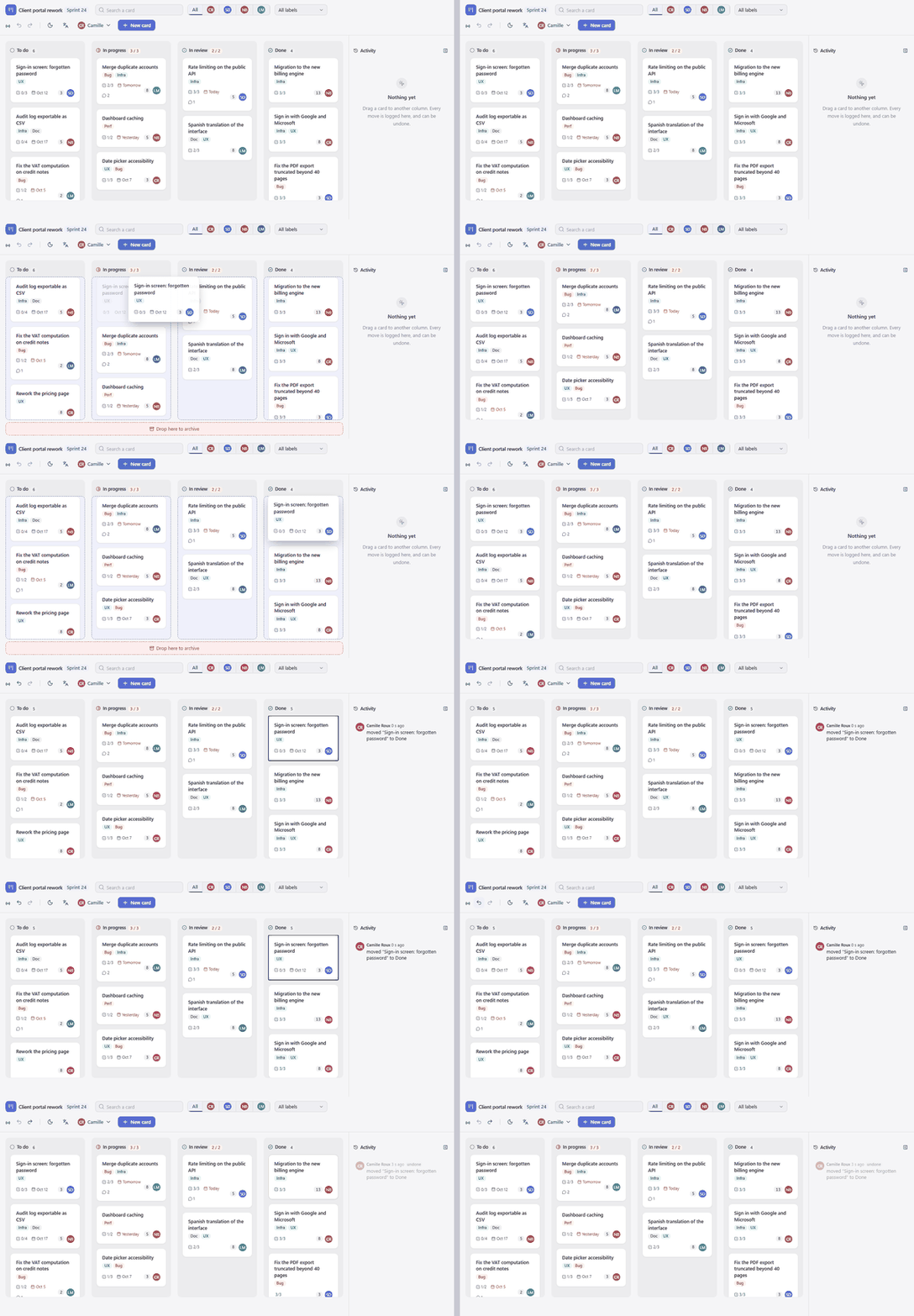
One Python app, two windows: drag on the left, the right follows; undo on the right, both follow. No JavaScript written.
Alpha: the latest public alpha is
0.1.0a6. APIs may change between alpha releases; only the latest alpha receives fixes.
See it first: component gallery · documentation · live Kanban and its API.
Requires Python 3.12, 3.13 or 3.14.
python -m pip install bretzel
bretzel new hello
cd hello
python -m pip install -e .
bretzel dev
Open http://127.0.0.1:8000, then edit app/features/home.py.
For an existing application:
bretzel dev my_package.main:app --port 8010Bretzel ships a Claude Code plugin. It installs from this repository:
claude plugin marketplace add JeanHoccart/bretzel
claude plugin install bretzel@bretzel
Then ask for a screen in plain words. Claude first builds a real mockup — a
throwaway Bretzel page on invented data, with the very components and theme
the app will ship — and shows you its screenshots in light and dark. You
validate it, and that same code becomes the working screen: nothing is
redrawn when it is wired. Meanwhile it reads the exact API from
bretzel describe, and bretzel check runs on every file it writes.
from bretzel import page, refreshable, ui
from bretzel.state import SessionState


class Counter(SessionState):
    value: int = 0


def increment() -> None:
    Counter().value += 1


@refreshable
def count() -> None:
    ui.heading(str(Counter().value))


@page("/", title="Counter")
def home() -> None:
    count()
    ui.button("+1", on_click=increment)
A @refreshable fragment follows the typed state it reads: when Counter
changes, Bretzel renders and ships only that fragment — there is no list of
dependencies to keep in sync. The same redraw reaches the other open
windows the state's scope allows — a SessionState stays in its session, an
AppState reaches everyone — without polling or subscription code.
- typed server and client state;
- more than 100 UI components;
- partial navigation and refreshable fragments;
- realtime updates over SSE;
- signed actions, CSRF protection and security headers;
- OAuth/OIDC doors and signed-cookie identity;
- drag-and-drop with server arbitration;
- server-rendered SVG charts;
bretzel describe,bretzel checkand browser probes;- a production wheel containing the readable and minified runtime.
Start with examples/pomodoro for a small application, examples/kanban for
realtime collaboration, examples/playground for the component catalogue and
examples/docs for the live reference.
NiceGUI keeps a live server-side UI object tree, Reflex compiles Python into a React application, and FastHTML stays deliberately close to HTML. Bretzel instead combines typed state, read by each fragment, with targeted server-rendered fragments, multi-user updates and 100+ integrated components, without a Node or Bun build pipeline. Coming from Streamlit or Dash, you keep the Python-first workflow and gain explicit state with partial updates instead of reruns or callback wiring. The detailed comparison, with sources: https://docs.bretzel-py.dev/compare.
bretzel/             framework source
examples/            complete demonstration applications
tests/               unit, integration and end-to-end suites
A bare pytest runs the unit and integration suites; pytest -m e2e runs the
end-to-end one.
Run the generated application as a regular ASGI app and provide a private secret through the environment:
BRETZEL_MODE=prod BRETZEL_SECRET_KEY="replace-with-a-random-secret" \
  uvicorn app.main:app --host 0.0.0.0 --port 8000
See SECURITY.md for private vulnerability reports and CONTRIBUTING.md for
the development workflow.
MIT — see LICENSE.