


scribe-eval is the open-source evaluation framework introduced in the SCRIBE
paper (Diagnostic Evaluation and Rich Transcription Models for Indic ASR,
accepted at Interspeech 2026). It provides fine-grained error metrics for
ASR systems on Indic languages (Malayalam, Kannada, Hindi, ...) and on
domain-specific transcription (legal, medical, technical).
Token categories are decomposed into base classes (LEXICAL, NUMERAL, PUNCT) and optional domain classes (LEGAL, MEDICAL, TECH, or custom). Domain-critical terminology is shielded from incorrect splitting and tracked separately — so a single misrecognized legal term doesn't inflate your general lexical error rate (ER_LEX).
pip install scribe-eval                 # core library
pip install 'scribe-eval[visualizer]'   # adds Streamlit UI
pip install 'scribe-eval[charts]'       # adds matplotlib charts
The core library depends only on levenshtein and tabulate. The extras are
optional and independent of each other.
To work on SCRIBE itself, install from source instead:
git clone https://github.com/adalat-ai-tech/scribe-eval.git
cd scribe-eval
pip install -e '.[visualizer,charts]'from scribe import compute_cer_scribe, text_error_rates, DomainConfig
ref = "charged u/s 302 IPC on 22.05.2023"
hyp = "charged u/s 303 IPC on 22.05.2023"
report = text_error_rates(ref, hyp, DomainConfig.legal())
print(f"ER_LEX: {report['LEXICAL']['error_rate']:.2%}")
print(f"ER_DOMAIN: {report['LEGAL']['error_rate']:.2%}")
print(f"ER_NUM: {report['NUMERAL']['error_rate']:.2%}")
cer = compute_cer_scribe(ref, hyp, DomainConfig.legal())
print(f"CER_SCRIBE: {cer['cer_scribe']:.2%}")- Domain-aware tokenization — shield domain terms from punctuation splitting; track errors separately
- Sandhi correction detection — identifies merged/split words common in Indic ASR
- Normalized error rates — combined denominator prevents misleading metrics for sparse categories
- CER_SCRIBE — character error rate on normalized token streams; format variants cost nothing, and it needs no sandhi machinery to be robust to agglutination
- Batch evaluation — evaluate in-memory records (
evaluate_records) or JSONL files with per-sample detail and dataset-level aggregation - Interactive visualizer — Streamlit UI with color-coded alignment, WER_SCRIBE/CER_SCRIBE/Accuracy metric tiles, category breakdown chart, frequent-error tables, and per-sample drill-down
| Category | Type | Label | Description |
|---|---|---|---|
| LEXICAL | base | ER_LEX | General words (Indic and English) |
| NUMERAL | base | ER_NUM | Numbers, dates, times (302, 22.05.2023, 10:30) |
| PUNCT | base | ER_PUNCT | Punctuation marks |
| LEGAL / MEDICAL / TECH / custom | domain | ER_DOMAIN | Domain terminology — bundled or your own |
One domain is active per evaluation: pass a single DomainConfig
(a bundled factory like DomainConfig.legal() or your own file via
DomainConfig.from_file); its error rate always reports as ER_DOMAIN.
See docs/domain-configuration.md.
Agglutination makes word boundaries unstable in Indic text: the same speech can be written as one word or two. SCRIBE detects such two-word merges and splits at alignment time and scores them as matches instead of errors. Real examples from evaluation data (each would count as 100% WER on its phrase without detection):
| Language | Reference | Hypothesis | Junction |
|---|---|---|---|
| Malayalam | അന്യായ പട്ടിക | അന്യായപ്പട്ടിക | gemination |
| Malayalam | എനിക്ക് അറിയാം | എനിക്കറിയാം | vowel elision |
| Kannada | ಪ್ರಧಾನ ಮಂತ್ರಿಗಳ | ಪ್ರಧಾನಮಂತ್ರಿಗಳ | compound merge |
| Kannada | ಮಿತ್ರರಾಷ್ಟ್ರಗಳು | ಮಿತ್ರ ರಾಷ್ಟ್ರಗಳು | compound split |
| Hindi | भाई साहब | भाईसाहब | compound spacing |
| Hindi | उस में | उसमें | postposition merge |
On an internal benchmark of 48 Malayalam legal dictations (private
data, not distributed with this repository), sandhi detection recovers
3.0 percentage points of WER_SCRIBE across 377 events that would
otherwise masquerade as recognition errors. The paired examples above
are directly reproducible: score any row with use_sandhi=True vs
use_sandhi=False in text_error_rates.
Detection is an orthographic heuristic, not a linguistic analysis — it is deliberately lenient and admits some false positives. See Sandhi detection: scope and limitations before relying on sandhi counts.
Factory methods for bundled domains: DomainConfig.legal(), DomainConfig.medical(), DomainConfig.technical()
File-based and custom inline configs are also supported. See docs/domain-configuration.md.
Evaluate a dataset from JSONL, one record per line:
{"text": "charged u/s 302 IPC on 22.05.2023", "pred_text": "charged u/s 303 IPC on 22-05-2023", "source_dataset": "legal-dictation"}
{"text": "witness PW1 deposed before the court", "pred_text": "witness PW 1 deposed before court", "source_dataset": "legal-dictation"}
{"text": "എനിക്ക് അറിയാം", "pred_text": "എനിക്കറിയാം", "source_dataset": "malayalam-read"}
from scribe import compute_sample_errors, compute_aggregate_metrics, print_evaluation_summary, DomainConfig
results = compute_sample_errors(
"predictions.jsonl", domain_config=DomainConfig.legal(), collect_error_details=True
)
print_evaluation_summary(compute_aggregate_metrics(results))DATASET | ER_LEX | ER_DOMAIN | ER_NUM | ER_PUNCT | WER_SCRIBE | CER_SCRIBE | SANDHI
OVERALL | 7.14% | 7.14% | 7.14% | N/A | 21.43% | 10.84% | 1
legal-dictation | 8.33% | 8.33% | 8.33% | N/A | 25.00% | 8.70% | 0
malayalam-read | 0.00% | N/A | N/A | N/A | 0.00% | 21.43% | 1
The Malayalam hypothesis merges a two-word compound; it is counted as a Sandhi
match, not as errors. N/A marks a category with no reference tokens and no
errors.
evaluate_records() accepts a list of dicts instead of a file path.
output_file= writes per-sample reports as JSONL. workers=N evaluates
samples in parallel.
Continuing from results above, with the [charts] extra installed:
from scribe import aggregate_error_details, compute_error_summary
from scribe.charts import category_breakdown_chart

summary = compute_error_summary(
    compute_aggregate_metrics(results)["overall"], aggregate_error_details(results), top_n=10
)
category_breakdown_chart(summary["contributions"], output_path="breakdown.png")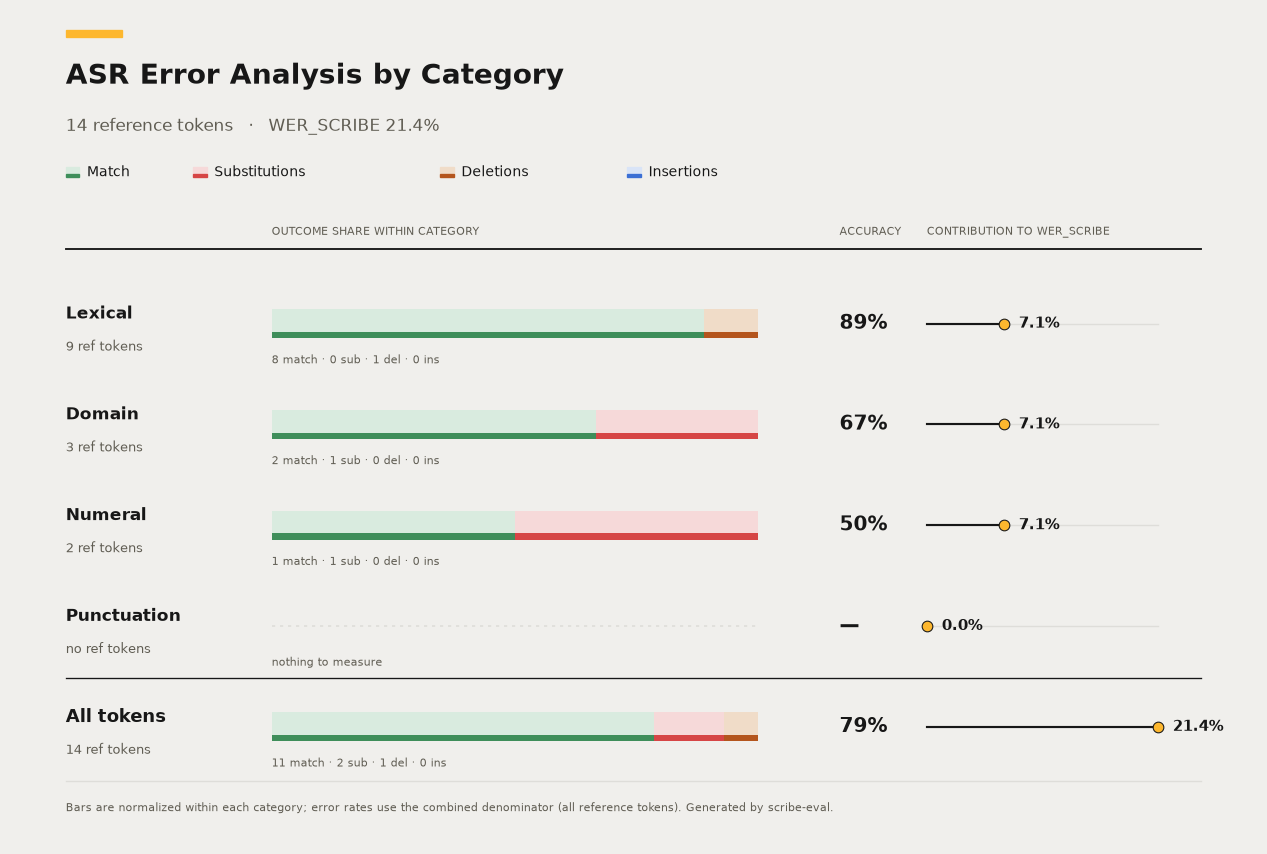
One row per category: a normalized outcome bar, an accuracy figure, and that category's contribution to WER_SCRIBE. Punctuation is marked "nothing to measure" because the reference carries no punctuation tokens.
Runnable scripts live in the repository under
examples/,
covering alignment, single-sample reports, domain configs, and a batch
command-line tool. They are not installed with the package, so clone the
repository to use them. See
docs/batch-processing.md
for the full batch API and output schema.
scribe-visualizer # requires the [visualizer] extra (see Installation)See docs/visualizer.md.
Core: levenshtein>=0.27.1, tabulate>=0.9.0
Optional extras: matplotlib (for [charts]), streamlit, pandas, matplotlib, and jiwer (for [visualizer] — jiwer powers the baseline WER/CER comparison tile).
git clone https://github.com/adalat-ai-tech/scribe-eval.git
cd scribe-eval
uv sync --all-extras # core + [charts] + [visualizer] + dev toolinguv run pytest # full suite
uv run pytest tests/test_analysis.py # one file
uv run pytest -k sandhi # name pattern (-k matches by substring)
uv run pytest -v # verbose, with each test name
uv run pytest --cov=scribe # with coverageTests are organised one file per library module under tests/, plus
tests/test_paper_cases.py for end-to-end golden
cases from the SCRIBE paper. pytest itself is part of the dev dependency
group, which uv sync installs by default.
uv run ruff check src tests examples       # lint
uv run ruff format src tests examples      # auto-format
See docs/architecture.md for the module map and a
glossary of project-specific terminology (sandhi, combined denominator, WER_SCRIBE, CER_SCRIBE,
Accuracy, ...).
The SCRIBE paper is accepted at Interspeech 2026. A preprint is available on arXiv: https://arxiv.org/abs/2605.20712
@article{manohar2026scribe,
  title={SCRIBE: Diagnostic Evaluation and Rich Transcription Models for Indic ASR},
  author={Manohar, Kavya and Bhattacharya, Arghya and Juvekar, Kush and Nethil, Kumarmanas},
  journal={arXiv preprint arXiv:2605.20712},
  year={2026}
}
To cite the software itself, use the "Cite this repository" button on GitHub (see CITATION.cff) or the Zenodo DOI: 10.5281/zenodo.20765419.
Licensed under the Apache License 2.0.
Developed as part of the Adalat AI initiative for Indic language technologies.