








A modern, GPU-accelerated Python package for robot manipulator kinematics, dynamics, planning, simulation, control, and perception.
Quick start • Documentation • Examples • Changelog • Contributing
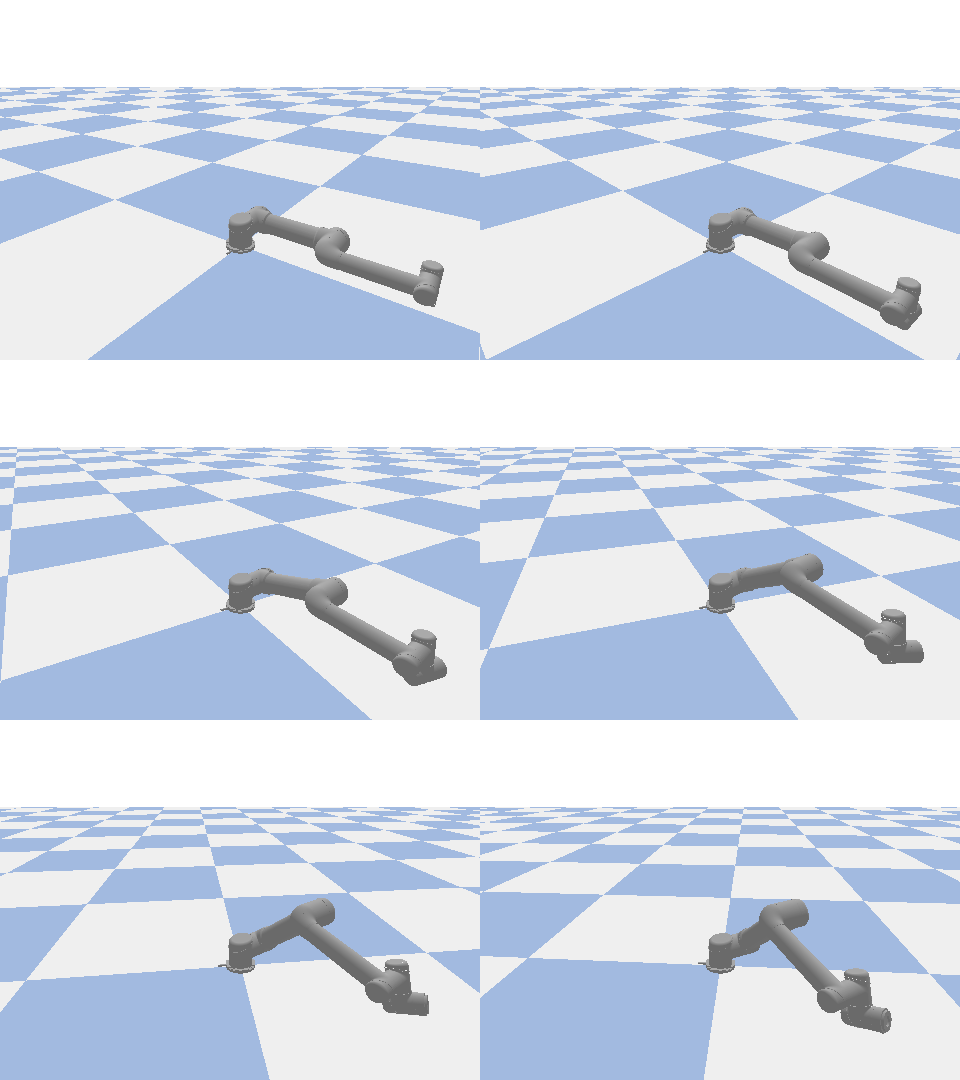
Most Python robotics packages cover one slice well — kinematics, simulation, or perception — and force you to glue the rest together. ManipulaPy ships the full stack with a consistent API:
- Unified surface — kinematics, dynamics, control, planning, simulation, and vision share the same
SerialManipulator/ManipulatorDynamicsobjects. - Differentiable, on four backends — the same kinematics and dynamics run on NumPy, CuPy, PyTorch, or JAX behind one dispatch API. Under PyTorch and JAX the core math is autodiff-safe, so
∂FK/∂θand∂(inverse dynamics)/∂θcome straight fromtorch.autogradorjax.grad— no finite differences, no second implementation to keep in sync. - GPU when it pays, CPU when it doesn't — CUDA trajectory and dynamics kernels auto-switch on problem size; the default install is lightweight (NumPy/SciPy/Matplotlib/Numba/Pillow) and heavy deps live behind optional extras.
- Production-ready URDF — native NumPy 2.0–compatible parser with
package://,file://, and ROS package discovery built in. - 25 bundled robots — Universal Robots, Fanuc, KUKA, Kinova, Franka, UFactory, Robotiq, ABB. Load any of them by name.
Fixes shipped in 1.4.2:
- Deterministic default end effector: no longer depends on
PYTHONHASHSEED, and it follows a documented rule. (7c7c27f) tip_linkvalidated against the joint chain: an unreachable link, or one with no actuated joint to the root, raisesValueError. (7c7c27f)extract_screw_axes(tip_link=...)uses only the root → tip chain: a Panda topanda_grasptargetnow gives 7 columns, not 8, and the newjoint_nameskey lists them. (7c7c27f)near_singularity_detectionfixed: it used to report every configuration as near-singular. The default threshold is now 1e3 on the condition number. (7e686ee)- ASCII import greeting on stderr: this fixes the crash on Windows cp1252 consoles, and stdout stays clean. (847b963)
extract_omega_listreturns 3 × n rotation axes for 6 × n screws: this fixesomega_listinURDF.to_serial_manipulator(). (1bf3b1e)
# Lightweight default — kinematics, dynamics, control, native URDF parser, CPU trajectories
pip install ManipulaPy

# Add the features you need:
pip install "ManipulaPy[simulation]"   # PyBullet physics + visualization
pip install "ManipulaPy[urdf]"         # trimesh-backed mesh loading
pip install "ManipulaPy[vision]"       # OpenCV + Ultralytics YOLO + torch
pip install "ManipulaPy[ml]"           # scikit-learn (DBSCAN clustering)
pip install "ManipulaPy[cuda]"         # CuPy 13.x for CUDA 12.x toolchains
pip install "ManipulaPy[pytorch]"      # PyTorch backend — differentiable core math
pip install "ManipulaPy[jax-cpu]"      # JAX backend (CPU); [jax-cuda] for CUDA 12
pip install "ManipulaPy[all]"          # everything above except the JAX GPU/TPU wheels
For CUDA 11.x toolchains use [gpu-cuda11]; for AMD/ROCm use [gpu-rocm]. Full matrix in the Installation Guide.
The default pip install ManipulaPy installs cleanly — all CPU features (kinematics, IK, dynamics, trajectory planning) work natively on macOS ARM. PyPI ships no pybullet wheel for Apple Silicon, so a source build can fail under Clang; if you need the [simulation] extra, install PyBullet from conda-forge first:
conda install -c conda-forge pybullet
pip install ManipulaPy            # or: pip install "ManipulaPy[simulation]"
CUDA/GPU features are not available on macOS — the [cuda] extra is skipped automatically (sys_platform != 'darwin').
| Supported | Notes | |
|---|---|---|
| Python | 3.9 – 3.12 | CI matrix runs all four; 3.12 added in v1.3.2 |
| OS | Linux (primary) · macOS · Windows | CUDA extras Linux-only |
| CPU stack | NumPy ≥ 2.0,< 3.0 · SciPy ≥ 1.13 · Numba ≥ 0.60 · Matplotlib ≥ 3.9 · Pillow ≥ 8.0 | Installed by default |
| GPU stack | CUDA 12.x via [cuda] · CUDA 11.x via [gpu-cuda11] |
NVIDIA, compute capability ≥ 6.0 |
| Simulation | PyBullet ≥ 3.2 | Optional, [simulation] extra |
| Vision | OpenCV ≥ 4.8.1 · Ultralytics ≥ 8.4 · PyTorch ≥ 2.7.1 | Optional, [vision] extra |
| Backends | PyTorch ≥ 2.7.1 via [pytorch] · JAX ≥ 0.6 via [jax-cpu] / [jax-cuda] |
Optional, differentiable core math |
import ManipulaPy
ManipulaPy.check_dependencies()    # ✅/❌ for each feature
import ManipulaPy prints a one-line ASCII greeting to stderr (since 1.4.2), and nothing to stdout. Set MANIPULAPY_QUIET=1 to hide it.
import numpy as np
from ManipulaPy.urdf import URDF
from ManipulaPy.ManipulaPy_data import get_robot_urdf
from ManipulaPy.path_planning import OptimizedTrajectoryPlanning

# Load any of the 25 bundled robots by name
robot_urdf = get_robot_urdf("ur5")
robot = URDF.load(robot_urdf)
serial = robot.to_serial_manipulator()
dynamics = robot.to_manipulator_dynamics()

# Forward kinematics
joint_angles = np.array([0.1, 0.2, -0.3, -0.5, 0.2, 0.1])
T = serial.forward_kinematics(joint_angles)
print("end-effector:", T[:3, 3])

# Trajectory planning — auto-switches to GPU when problem is large enough
planner = OptimizedTrajectoryPlanning(
    serial, robot_urdf, dynamics, joint_limits=[(-np.pi, np.pi)] * 6,
)
traj = planner.joint_trajectory(
    thetastart=np.zeros(6), thetaend=joint_angles,
    Tf=5.0, N=1000, method=5,   # 5 = quintic; 3 = cubic; 1 = linear
)
print(f"trajectory: {traj['positions'].shape[0]} points")
That snippet runs end-to-end on a default pip install ManipulaPy — no GPU required. With the [cuda] extra installed, the planner transparently routes large problems (≥ ~1000 waypoints) through the CUDA kernels for 40×+ speedup.
The same serial / dynamics objects from the demo above feed every module. The snippets below build on that setup.
from ManipulaPy.kinematics import SerialManipulator  # already loaded as `serial`

# Target pose: 30 cm forward, 20 cm up, no rotation change
T_target = serial.forward_kinematics(np.zeros(6))
T_target[:3, 3] += np.array([0.30, 0.0, 0.20])

# 1. Damped least-squares (fast, single seed)
q_dls, ok, _iters = serial.iterative_inverse_kinematics(
    T_target, thetalist0=np.zeros(6),
)

# 2. Smart IK — picks an initial guess based on a workspace heuristic
q_smart, ok, _iters = serial.smart_inverse_kinematics(
    T_target, strategy="workspace_heuristic", theta_current=np.zeros(6),
)

# 3. Robust multi-start + SQP fallback for tough poses
q_robust, ok, _attempts, solver_name = serial.robust_inverse_kinematics(
    T_target, max_attempts=10,
)
smart_inverse_kinematics picks an initial guess strategy (workspace heuristic, cached previous solution, etc.) and dispatches to the underlying DLS / SQP / TRAC-IK solver — see ManipulaPy/ik_helpers.py.
q  = np.array([0.1, 0.2, -0.3, -0.5, 0.2, 0.1])
qd = np.zeros(6)
qdd_des = np.array([0.1, 0.0, -0.1, 0.0, 0.0, 0.0])
g = np.array([0.0, 0.0, -9.81])
F_ext = np.zeros(6)

M = dynamics.mass_matrix(q)                              # (n, n)
c = dynamics.velocity_quadratic_forces(q, qd)            # (n,)
g_forces = dynamics.gravity_forces(q, g)                 # (n,)
tau = dynamics.inverse_dynamics(q, qd, qdd_des, g, F_ext)  # required torques
qdd = dynamics.forward_dynamics(q, qd, tau, g, F_ext) # resulting accelfrom ManipulaPy.control import ManipulatorController
ctrl = ManipulatorController(dynamics)
Kp, Ki, Kd = np.full(6, 80.0), np.full(6, 1.5), np.full(6, 20.0)
q_des = np.array([0.2, -0.1, 0.4, -0.3, 0.1, 0.0])
# PID step (joint-space)
tau_pid = ctrl.pid_control(
thetalistd=q_des, dthetalistd=np.zeros(6),
thetalist=q, dthetalist=qd,
dt=0.01, Kp=Kp, Ki=Ki, Kd=Kd,
)
# Computed-torque step (cancels the nonlinear dynamics)
tau_ctc = ctrl.computed_torque_control(
thetalistd=q_des, dthetalistd=np.zeros(6), ddthetalistd=np.zeros(6),
thetalist=q, dthetalist=qd,
g=g, dt=0.01, Kp=Kp, Ki=Ki, Kd=Kd,
)
# Ziegler-Nichols auto-tuning from a measured ultimate gain/period
Kp_t, Ki_t, Kd_t = ctrl.ziegler_nichols_tuning(Ku=120.0, Tu=0.65, kind="PID")Also available: robust_control, adaptive_control, feedforward_control, kalman_filter_control, plus settling-time / overshoot / rise-time analysis helpers.
from ManipulaPy.sim import Simulation

sim = Simulation(
    urdf_file_path=robot_urdf,
    joint_limits=[(-np.pi, np.pi)] * 6,
    torque_limits=[(-150, 150)] * 6,
    time_step=1/240,
)
sim.initialize_robot()
sim.set_robot_models(serial, dynamics)
sim.run_trajectory(traj["positions"])     # replay the planner output
sim.close_simulation()
Simulation works headlessly through PyBullet DIRECT mode (CI-friendly) or with the GUI sliders enabled. Trajectory replay, joint-parameter sliders, end-effector trail visualization, and a reset button are all built in.
from ManipulaPy.vision import Vision
from ManipulaPy.perception import Perception

vision = Vision(camera_configs=[{"device_index": 0, "intrinsic_matrix": K}])
rgb = vision.capture_image(camera_index=0)
# `depth` here is a same-shape ndarray from a depth sensor or stereo reconstruction.

# YOLOv8 detection + depth back-projection in one call (requires [vision])
positions, labels = vision.detect_obstacles(
    depth_image=depth, rgb_image=rgb, depth_threshold=5.0,
)

# Or go one level up: capture + detect + DBSCAN cluster (requires [vision, ml])
perception = Perception(vision_instance=vision)
points, cluster_labels = perception.detect_and_cluster_obstacles(
    camera_index=0, depth_threshold=5.0, eps=0.05, min_samples=10,
)
Stereo rectification, disparity, and 3D point-cloud generation live on the same Vision class — see Examples/advanced_examples/stereo_vision_advanced_demo.py.
ManipulaPy/
├── backend/             # Array-backend protocol + registry — NumPy · CuPy · PyTorch · JAX
├── utils/               # SO(3)/SE(3) screw math, exponentials, logarithms, time scaling
├── kinematics/          # SerialManipulator — FK, IK (DLS/SQP/TRAC-IK/smart), Jacobians
├── dynamics/            # ManipulatorDynamics — M, C, g, inverse / forward dynamics
├── control/             # ManipulatorController — PID, CTC, adaptive, robust, Kalman
├── planning/            # OptimizedTrajectoryPlanning — CPU/GPU quintic·cubic·linear
├── singularity/         # Manipulability ellipsoid, condition number, MC workspace
├── potential_field/     # Attractive + repulsive fields (sign-corrected in v1.3.2)
├── urdf/                # Native URDF parser — package://, file://, ROS discovery
│   ├── parser.py        #   v1.3.2: NumPy 2.0 compatible, no urchin dependency
│   ├── resolver.py      #   PackageResolver — explicit overrides + auto-discovery
│   └── scene.py         #   Visualization / kinematic tree introspection
├── sim/                 # PyBullet wrapper                        [simulation]
├── vision.py            # OpenCV + Ultralytics YOLO + stereo      [vision]
├── perception.py        # Depth → obstacles + DBSCAN clustering   [vision, ml]
├── cuda_kernels/        # Numba/CuPy kernel registry              [cuda]
└── ManipulaPy_data/     # 25 bundled robot URDFs + meshes
The library is layered: every higher-level module depends only on the ones above it in this list. You can use kinematics / dynamics / control / planning end-to-end with zero optional dependencies installed.
Most of these were single modules before v1.4 and became packages during the backend migration. Existing imports keep working — ManipulaPy.path_planning and ManipulaPy.ik_helpers remain importable as compatibility shims, and the public API is frozen by a regression test.
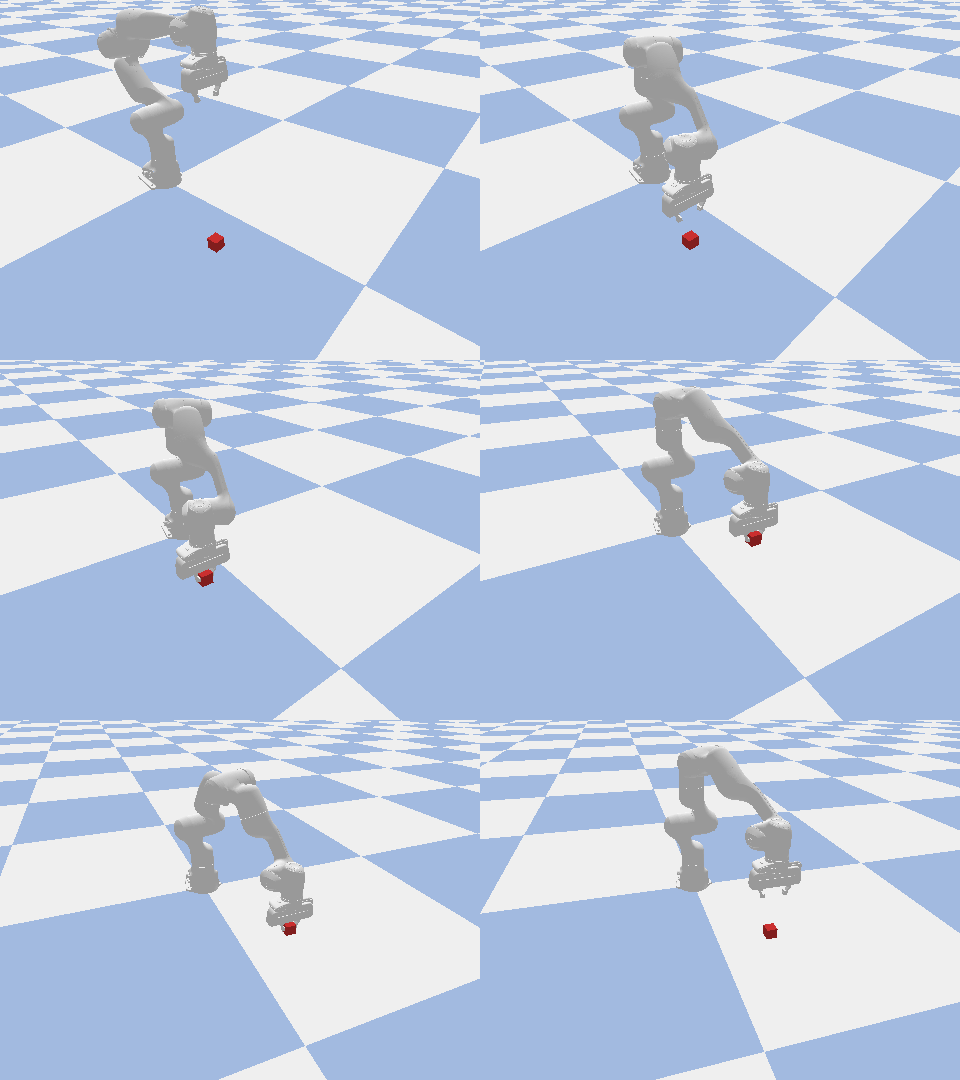
Pick and place Panda lifts a cube to a new pose along a quintic-timed path. |
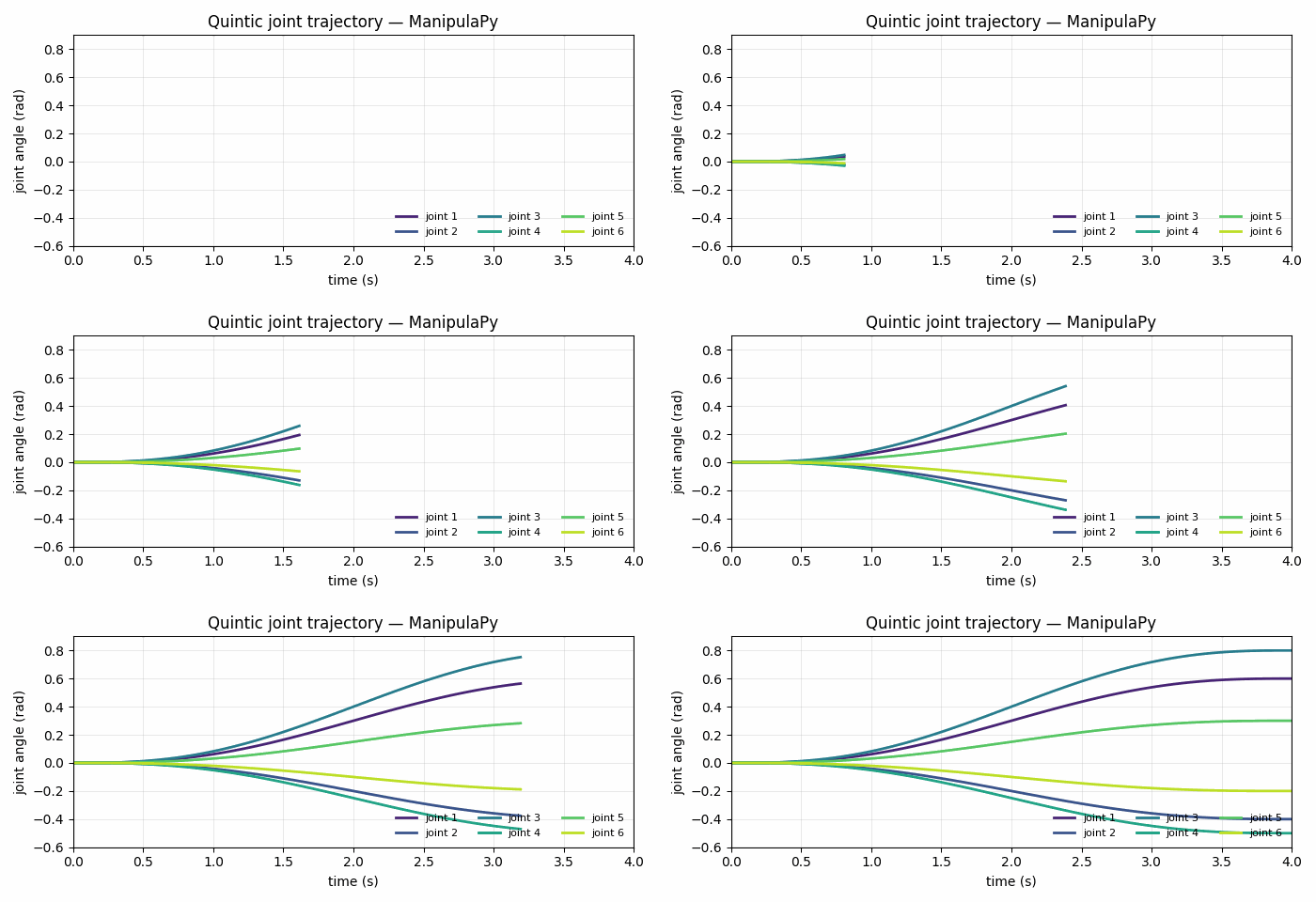
Trajectory planning Quintic time-scaled joint trajectory, CPU or CUDA. |
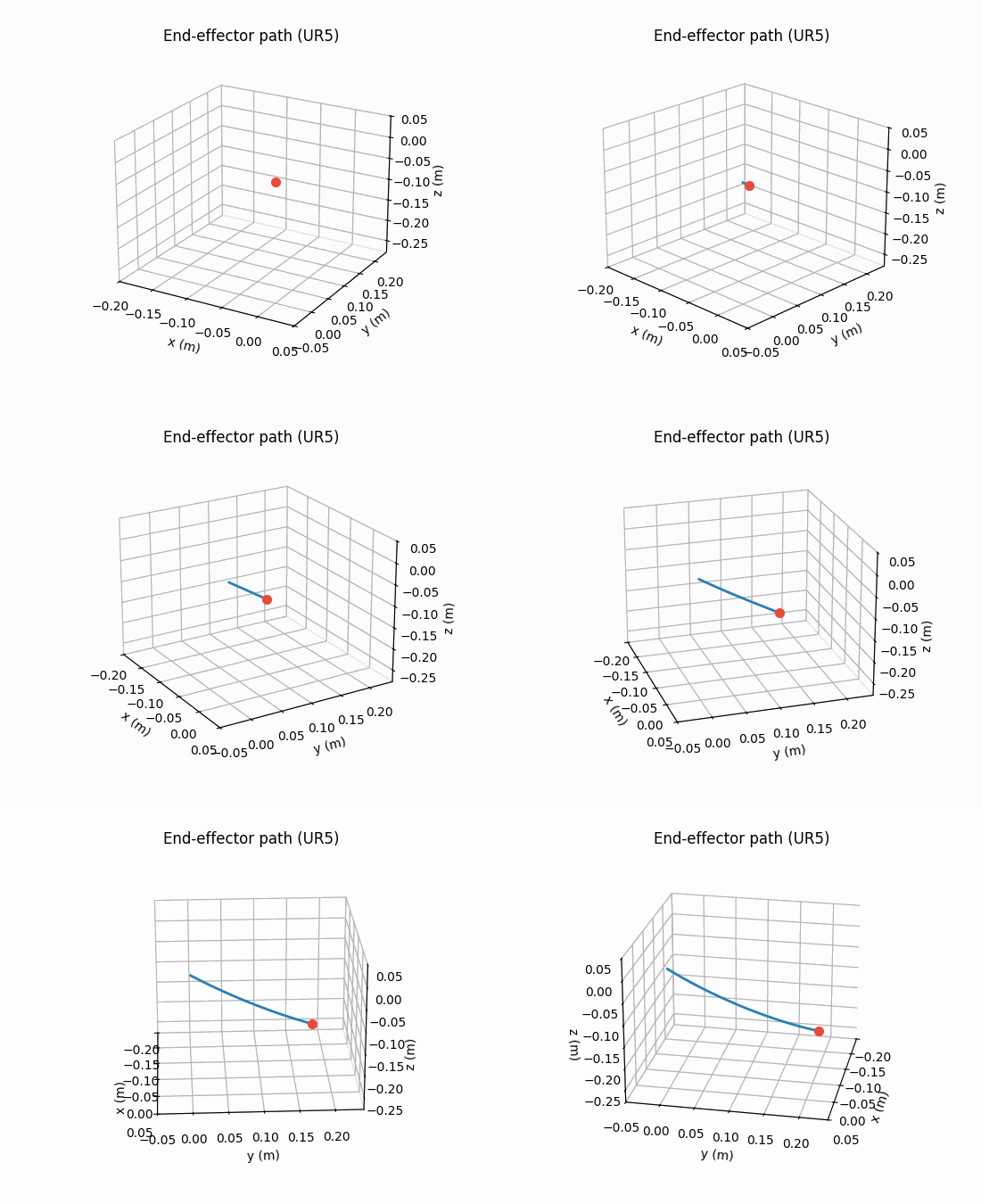
Forward kinematics End-effector path computed from the same trajectory. |
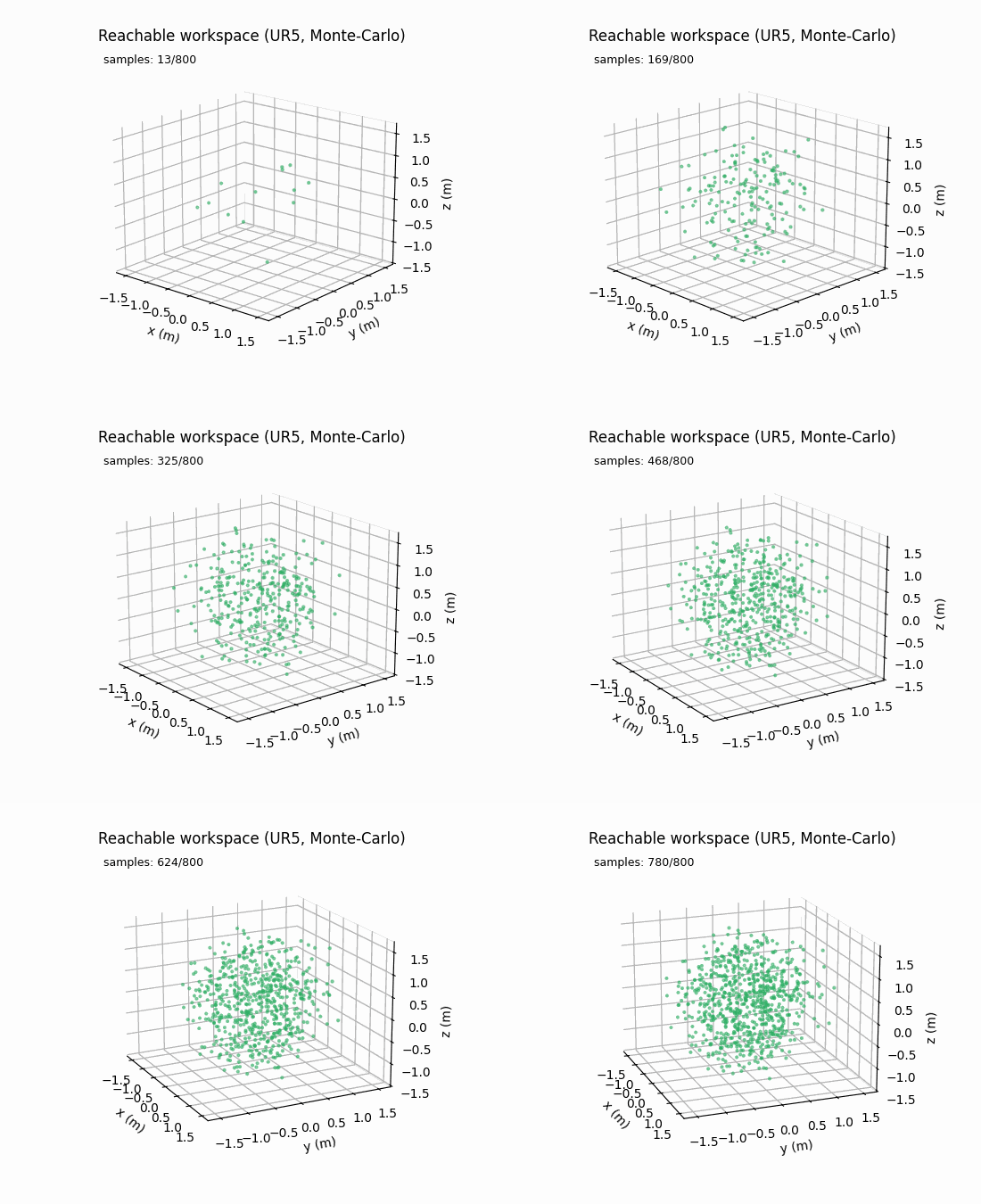
Workspace analysis Monte-Carlo reachable workspace, GPU-accelerated. |
All visuals are rendered from the live API — joint and trajectory plots through matplotlib.animation, robot bodies through ManipulaPy.urdf.URDF + PyBullet's headless renderer.
- Kinematics — forward + inverse (DLS, SQP, TRAC-IK, multi-start), Jacobians, geometric error model
- Dynamics — mass matrix, Coriolis/centrifugal, gravity, inverse/forward dynamics
- Control — PID, computed torque, adaptive, robust, Kalman filtering, Ziegler-Nichols auto-tuning
- Singularity analysis — manipulability ellipsoid, condition number, Monte-Carlo workspace
- Native URDF parser —
package://,file://, ROS package discovery, explicitPackageResolveroverrides
[simulation]— PyBullet physics, GUI sliders, collision checking, trajectory replay[urdf]— trimesh-backed mesh loading for visualization[vision]— OpenCV + Ultralytics YOLO + stereo + 3D point clouds[ml]— DBSCAN-based obstacle clustering on top of vision[cuda]— CuPy/Numba CUDA kernels: trajectory generation (40×+), batch trajectories (20×+), inverse dynamics (100×+), Monte-Carlo workspace (10×+)[pytorch]/[jax-cpu]/[jax-cuda]— differentiable backends for the core math;∂FK/∂θand∂(inverse dynamics)/∂θstraight fromtorch.autogradorjax.grad
UR3 / UR5 / UR10 / UR3e / UR5e / UR10e / UR16e · Fanuc LR Mate 200iB, M-16iB, CRX-5/10/20/30iA · KUKA iiwa7 / iiwa14 · Kinova Gen3, Jaco 6-DOF, Jaco 7-DOF · Franka Panda · UFactory xArm6 (± gripper) · Robotiq 2F-85 / 2F-140 · ABB IRB 2400.
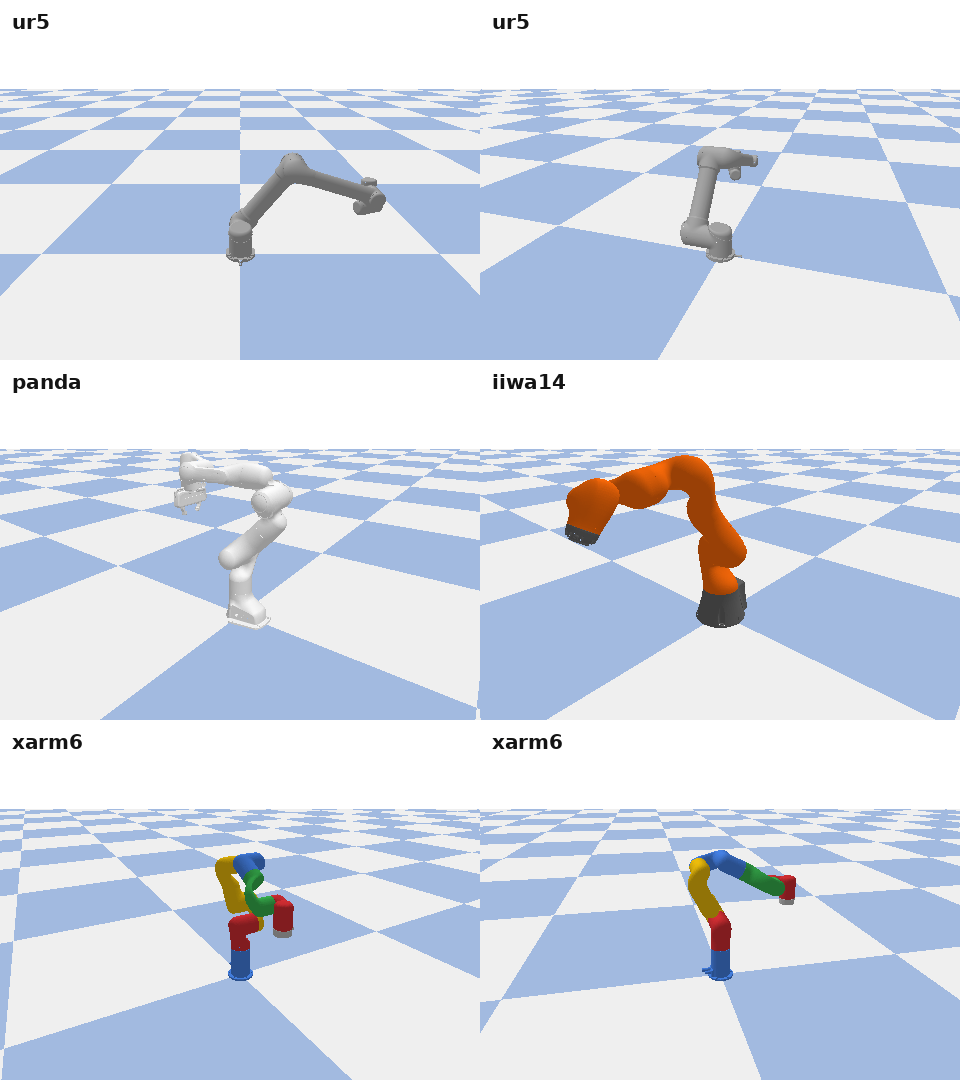
Every model loads end-to-end through ManipulaPy.urdf.URDF.load(...) and renders in PyBullet via ManipulaPy.urdf.PackageResolver — no ROS workspace or external mesh setup required.
from ManipulaPy.ManipulaPy_data import list_robots, print_robot_catalog
print(list_robots())          # iterable of robot keys
print_robot_catalog()         # printable table with specs
Full inventory and per-robot details in ManipulaPy/ManipulaPy_data/MANIFEST.md.
| Tutorials & user guide | manipulapy.readthedocs.io |
| API reference | API docs |
| Installation matrix | docs/source/Installation Guide.rst |
| Runnable examples | Examples/ — basic, intermediate, advanced tracks |
| Package layout | README section |
| Release history | CHANGELOG.md |
The Examples/ tree is the fastest way in. Start at Examples/basic_examples/ (no extras required), move to Examples/intermediate_examples/, then Examples/advanced_examples/ for the full GPU + vision pipelines.
The Examples/ directory has three tracks — each script is self-contained and runnable directly. Full details in Examples/README.md.
| Script | Demonstrates |
|---|---|
kinematics_basic_demo.py |
Forward & inverse kinematics fundamentals |
dynamics_basic_demo.py |
Mass matrix, Coriolis, gravity, inverse/forward dynamics |
control_basic_demo.py |
PID and computed-torque control basics |
urdf_processing_basic_demo.py |
Loading & inspecting a robot from URDF |
visualization_basic_demo.py |
Robot analysis and Matplotlib plotting |
| Script | Demonstrates | Needs |
|---|---|---|
trajectory_planning_intermediate_demo.py |
Quintic/cubic trajectories with CPU/GPU auto-dispatch | core · [cuda] optional |
control_comparison_intermediate_demo.py |
Side-by-side PID / computed-torque / robust control | core |
singularity_analysis_intermediate_demo.py |
Manipulability ellipsoid, condition number, workspace | core |
simulation_intermediate_demo.py |
PyBullet physics and trajectory replay | [simulation] |
perception_intermediate_demo.py |
YOLO detection + obstacle clustering | [vision] |
| Script | Demonstrates | Needs |
|---|---|---|
gpu_acceleration_advanced_demo.py |
CUDA kernels and CPU↔GPU speedup comparison | core · [cuda] for GPU |
batch_processing_advanced_demo.py |
Batched trajectory generation across many goals | core · [cuda] optional |
optimal_control_advanced_demo.py |
Trajectory-tracking control comparison | core |
collision_avoidance_advanced_demo.py |
Potential-field collision avoidance | core |
real_robot_integration_advanced_demo.py |
End-to-end robot integration in PyBullet | [simulation] |
stereo_vision_advanced_demo.py |
Stereo rectification, disparity, and 3D point clouds | [vision] |
# basic — works on any install
python Examples/basic_examples/kinematics_basic_demo.py

# intermediate / advanced — install the extra the script needs first
python Examples/intermediate_examples/simulation_intermediate_demo.py # [simulation]The full release notes are in CHANGELOG.md. The headline is the unified backend system: one dispatch API over NumPy, CuPy, PyTorch, and JAX.
from ManipulaPy.backend import use_backend

with use_backend("jax"):
    T = robot.forward_kinematics(theta)      # same call, JAX arrays out

# gradients come from the framework, not from finite differences
import jax
dT_dtheta = jax.jacrev(robot.forward_kinematics)(theta)- Four backends, one API —
set_backend(...)/use_backend(...)select the array library. The default stays NumPy, and the public return contract under the default backend is frozen, so existing code and the ROS wrapper are unaffected. - A tested differentiable contract —
utils,kinematics,dynamics, andsingularityare trace-safe and carry autodiff gradient tests on both PyTorch and JAX. Every other module runs on all four backends via host-boundary conversion, but carries no gradient guarantee — see the backend guide for exactly where that line sits. - Optional accelerator extras —
[pytorch],[jax-cpu], and[jax-cuda]. The base install remains NumPy-only. - TPU is not supported, and there is no TPU extra. Validating one on a real
TPU v5e found two blocking limits. XLA:TPU implements no float64 LU
decomposition and no int64 dot, so
inv,solveand every dynamics path built on them raiseUNIMPLEMENTED. The float64 matmuls that do run land at float32 accuracy — forward kinematics deviates from NumPy by ~3e-8 even withPrecision.HIGHEST, because the MXU is bf16-native. The JAX backend enablesjax_enable_x64unconditionally, so TPU cannot satisfy its contract. This is a hardware/precision mismatch, not a tolerance question; supporting TPU needs a per-platform precision domain in the backend. - Core math fixes that affect every backend — building the gradient contract
exposed three real defects in the shipped SE(3)/SO(3) code:
MatrixLog6discarded small rotations, log gradients were NaN near the identity, and the rotation angle was ill-conditioned near π. All three produced wrong or non-finite results on NumPy too, not just on the new backends. - URDF
package://containment — a mesh reference can no longer resolve outside the robot-description directory. Non-ROS sibling directories are no longer auto-discovered by name; pin those withadd_package()oradd_search_path().
Numbers below come from artifacts generated by the bundled Benchmark/ suite. Hardware: 6-DOF xArm6, CPU path (no CUDA), Python 3.10.
From a local accuracy_benchmark_results/accuracy_benchmark_results.json artifact generated by python -m Benchmark.accuracy_benchmark:
| Component | Mean time | Accuracy |
|---|---|---|
| Forward kinematics | 0.29 ms | 100 % success, consistency error 0.0 |
| Jacobian | 0.27 ms | 100 % success |
| Mass matrix + Coriolis + gravity | 1.19 ms | consistency 2.8 × 10⁻¹⁵ |
| Inverse dynamics | 1.19 ms | 100 % success |
| Forward dynamics | 1.17 ms | 100 % success |
| Trajectory planning (N = 200, quintic) | 0.053 ms | boundary err 2.1 × 10⁻⁷ |
| Trajectory planning (N = 500, cubic) | 0.060 ms | boundary err 2.0 × 10⁻⁷ |
| PID control step | 0.008 ms | 100 % success |
| Singularity detection | 0.83 ms | 100 % known-singular detection |
From Benchmark/ik_branch_benchmark_results.json — v1.3.2 production code path:
| Solver | Success rate | Median | Mean | p95 |
|---|---|---|---|---|
iterative_inverse_kinematics (DLS) |
90 % | 11 ms | 210 ms | 1929 ms |
smart_inverse_kinematics |
96 % | 29 ms | 1870 ms | 5944 ms |
robust_inverse_kinematics |
96 % | 27 ms | 908 ms | — |
Median is the right number for typical poses; mean is dragged up by the long tail of hard targets that hit the max-iterations cap. smart_inverse_kinematics has the highest success rate but pays for it in retries — pick by your latency vs. coverage budget.
With the [cuda] extra installed (pip install "ManipulaPy[cuda]"), the trajectory planner, batch trajectory generator, inverse dynamics over a trajectory, and Monte-Carlo workspace sampler all route through Numba / CuPy CUDA kernels. The planner falls back to CPU below its adaptive N * joints threshold so small problems don't pay PCIe transfer overhead.
Speedups are workload- and GPU-dependent — reproduce on your own hardware with:
python -m Benchmark.performance_benchmark   # full CPU vs GPU sweep
python -m Benchmark.quick_benchmark         # CI-friendly subset
The full benchmark suite (Benchmark/README.MD) covers kinematics, dynamics, trajectory planning, control, vision, and singularity analysis across problem sizes from N = 100 to N = 50,000.
Bug reports, feature requests, and pull requests welcome. The flow is documented in CONTRIBUTING.md; the short version:
- Fork → branch → make the change →
python -m pytest tests/ -qshould be green. - New behavior needs a regression test in
tests/test_v132_regressions.py(or a sibling file). - Surgical edits over speculative refactors.
- Open a PR against
main. CI runs Python 3.9 – 3.12.
If you use ManipulaPy in academic work, please cite the JOSS paper:
@article{aboelnasr2025manipulapy,
  title   = {ManipulaPy: A GPU-Accelerated Python Framework for Robotic Manipulation, Perception, and Control},
  author  = {AboElNasr, M. I. M.},
  journal = {Journal of Open Source Software},
  year    = {2025},
  volume  = {10},
  number  = {114},
  pages   = {8490},
  doi     = {10.21105/joss.08490},
  url     = {https://doi.org/10.21105/joss.08490}
}
Paper source: paper/paper.md · published in JOSS: 10.21105/joss.08490.
AGPL-3.0-or-later. Free for research, education, and AGPL-compatible commercial use; network-deployed services must publish source.
All runtime dependencies are AGPL-compatible: NumPy/SciPy/Matplotlib (BSD), Numba/CuPy (BSD/MIT), Pillow (HPND), PyBullet (Zlib), OpenCV (Apache 2.0), Ultralytics (AGPL-3.0), Trimesh (MIT).
Maintained by Mohamed Aboelnasr.